Exploring the Question: Jesus – Prophet or God?
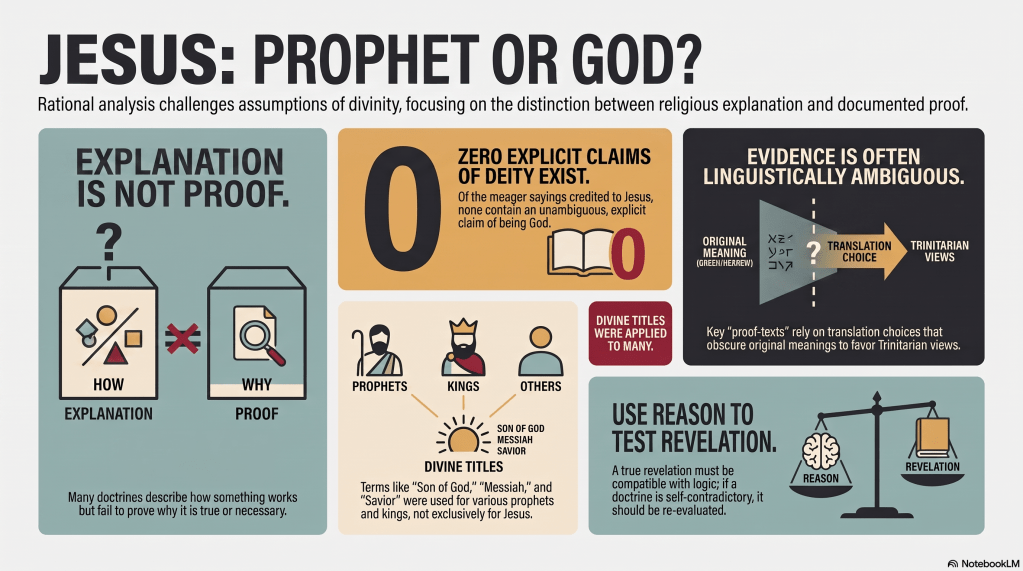
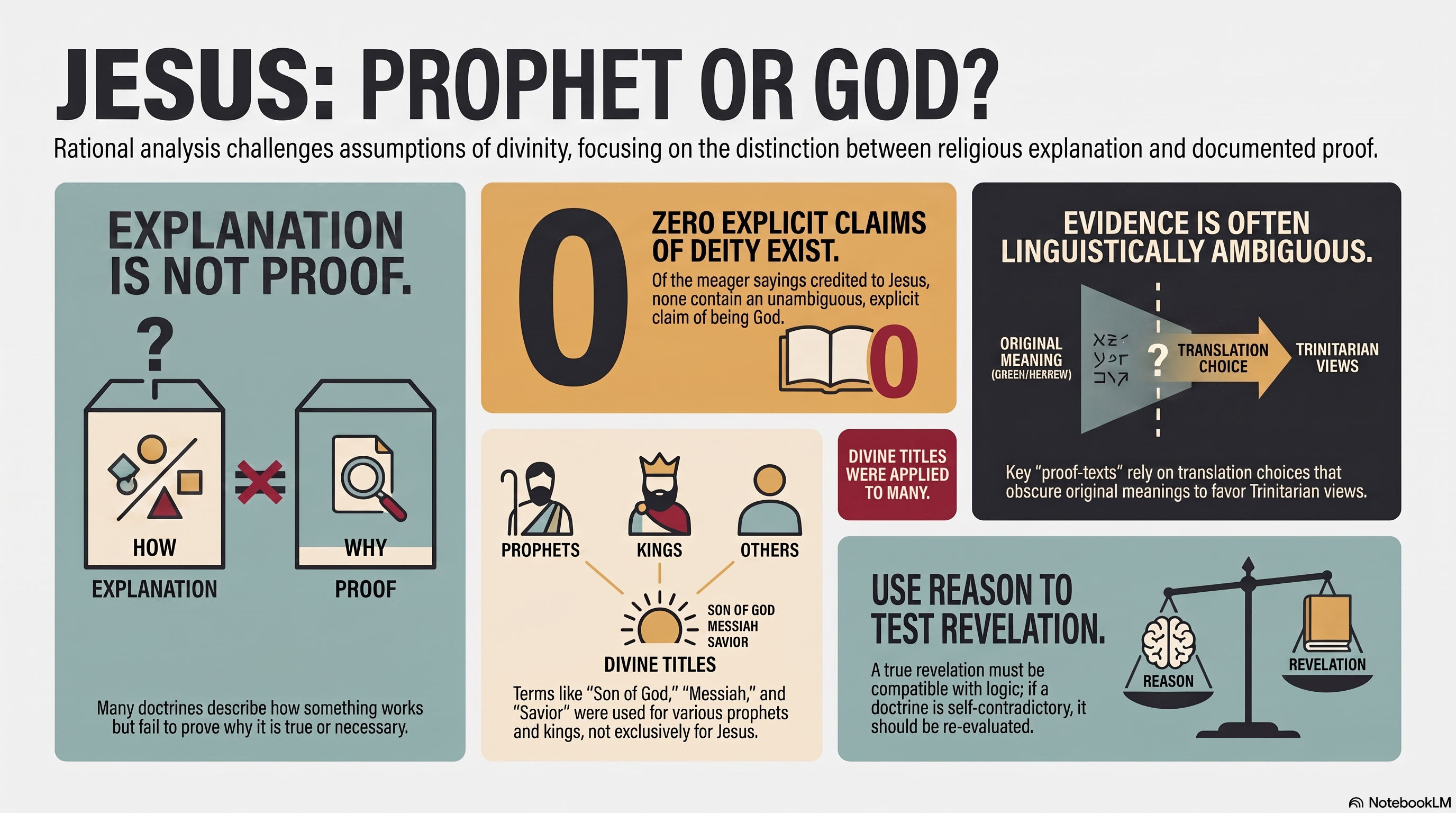
When we look at big religious questions, using logic and reason can help us see things more clearly. The infographic Jesus__Prophet_or_God_.png breaks down how we can look at claims about Jesus’s divinity using a simple, rational approach.
Here are the four main ideas from the graphic:
1. Saying How is Not Proving Why
There is a big difference between an explanation and proof. A religious doctrine might explain exactly how a belief works, but that doesn’t prove why it is actually true.
2. Lost in Translation
The words we read today have passed through a lot of history. Many important text passages rely on specific translation choices that can change or hide the original Greek or Hebrew meanings. Often, translations are chosen to fit later religious views rather than sticking to the original context.
3. Titles Were Used for Many People
In ancient history, titles like “Son of God,” “Messiah,” and “Savior” were not unique to just one person. They were commonly given to various prophets, kings, and leaders of the time. Additionally, when looking at the actual sayings credited to Jesus, there are zero explicit, unambiguous claims where he says he is God.
4. Logic Matters
Finally, the graphic reminds us to use our brains to test religious ideas. A true revelation should make logical sense. If a religious idea contradicts itself, a sensible approach is to pause and re-evaluate it.




What do you think?